The idea
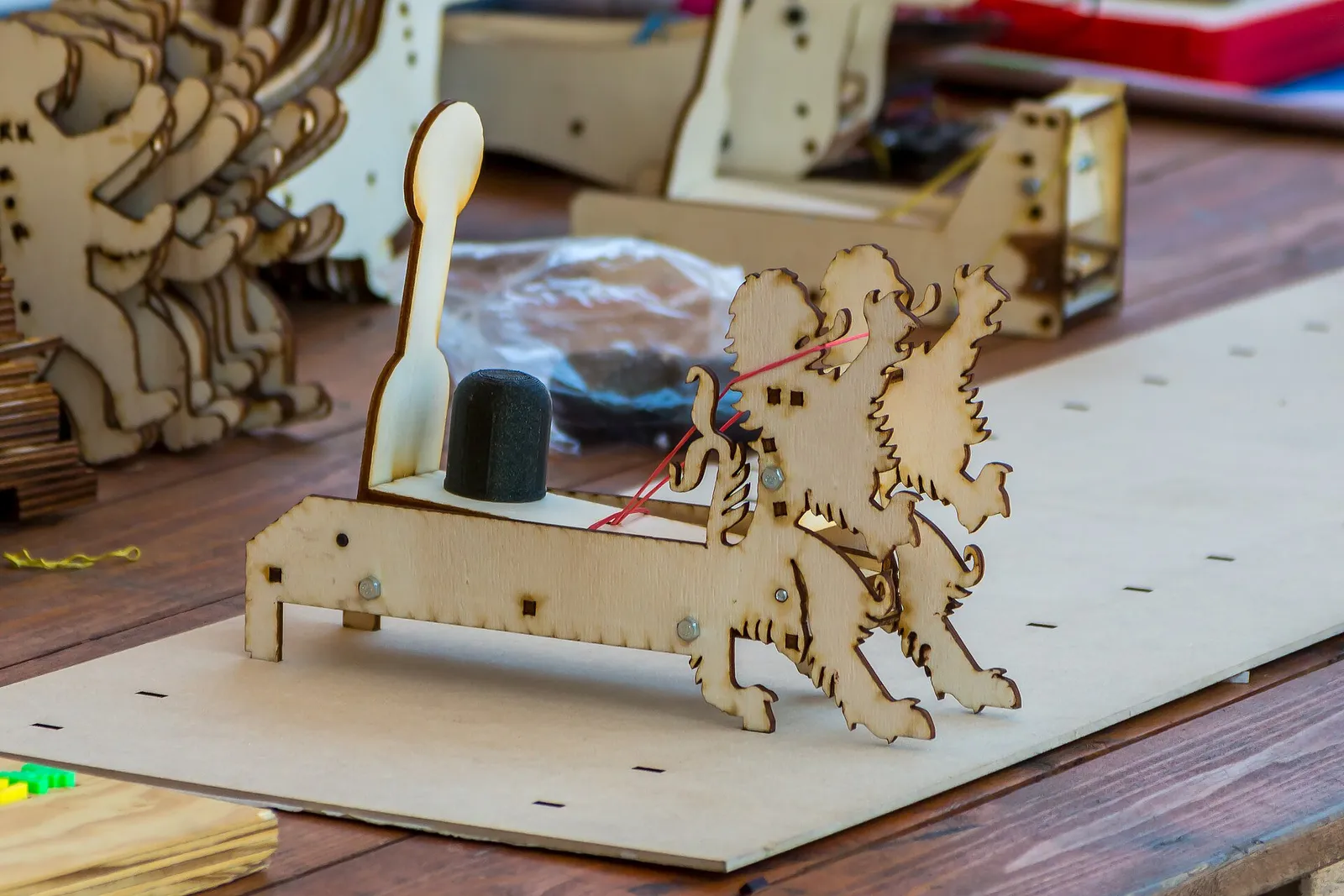
A small catapult made from about eight plywood parts: two side frames, a base, a cross-brace, a throwing arm with a cup, and a stop bar. A rubber band provides the spring. It flat-packs into an envelope, so it makes a good kit for a classroom or a party.
Designing the parts
- Side frames: two identical triangles or A-frames with a hole for the pivot dowel and slots for the base and cross-brace.
- Base and brace: rectangles with tabs that fit the side-frame slots. Use the kerf allowance you found when making a finger-jointed box.
- Throwing arm: a long strip with a hole for the pivot near one end and a shallow cup (two stacked rings) at the other.
- Stop bar: a crosspiece that halts the arm at roughly 90°, so missiles fly forwards rather than straight up.
- Band anchors: two notches on the base and one on the arm to hook the rubber band.
Build and test
Slot the frame together, push the dowel through the frames and arm, and hook the band. Launch only soft things — a mini marshmallow or a pom-pom — and never aim at people or pets.
Make it a lesson
- Move the band anchor along the arm and measure the range each time.
- Try a longer or shorter arm and compare.
- Engrave a ruler scale on the base for quick measurements.