The five rules
- Never leave a laser running unattended. Glowforge tells owners to stay within sight and look inside often — and for its Craft Series machines that applies even while a job is paused and ready to start (Glowforge Craft Series safety). xTool gives the same instruction (xTool D1 safety guide).
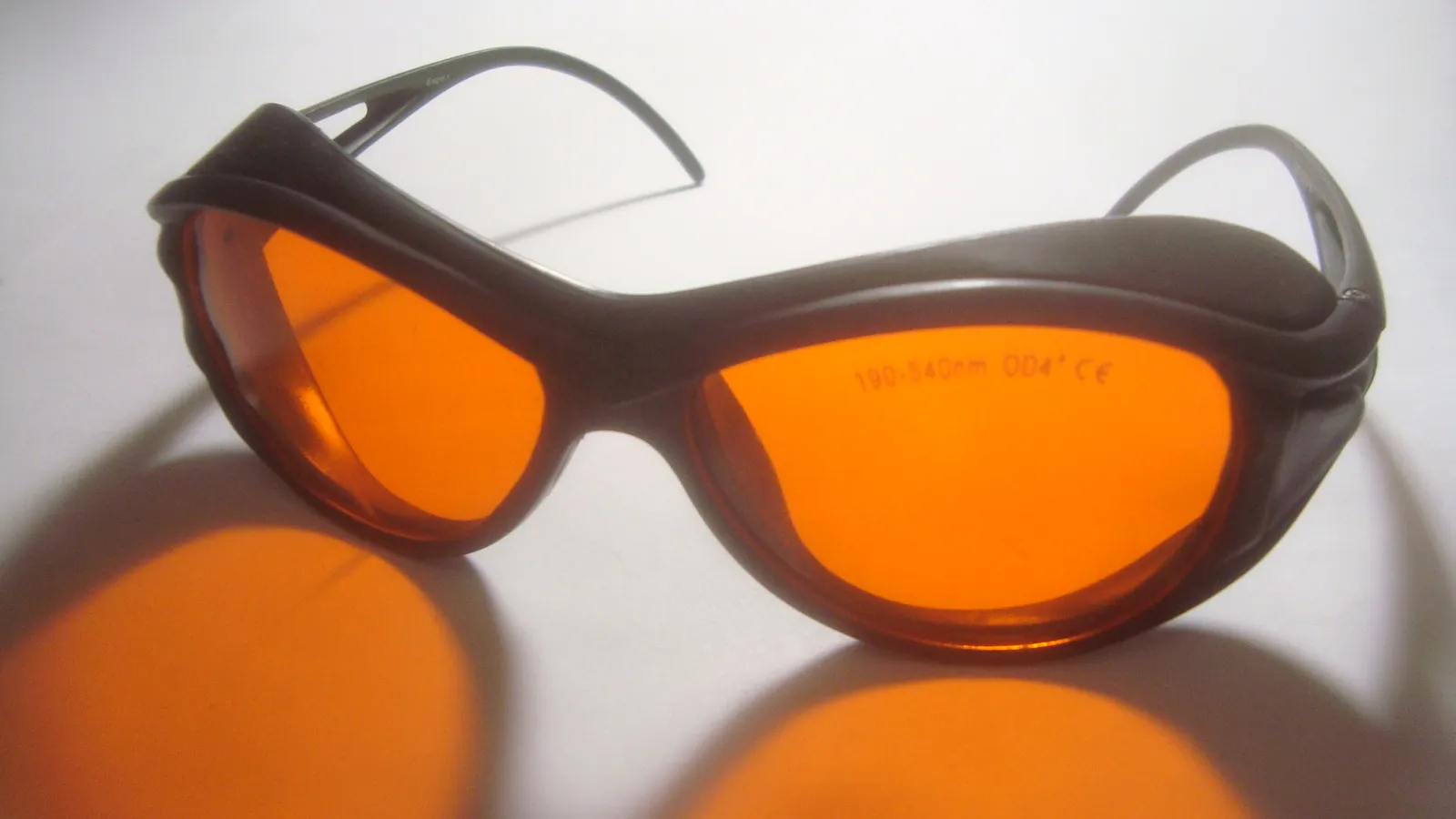
- Wear eye protection made for your laser’s wavelength whenever the beam isn’t fully enclosed.
- Vent fumes outside or through a proper filter.
- Only laser materials you have positively identified as safe. Never PVC or vinyl — see our materials guide.
- Keep a suitable extinguisher nearby and keep the machine clean.
Laser classes in plain English
Laser products sold in the UK are classified under the British standard BS EN 60825-1, which has eight classes: 1, 1M, 1C, 2, 2M, 3R, 3B and 4. The higher the number, the greater the potential for harm (UKHSA).
| Class | What UKHSA says it means |
|---|---|
| Class 1 | Safe in normal use. Also covers powerful lasers that are fully enclosed so no hazardous light can get out. |
| Class 2 / 2M | Visible lasers that are safe for short, accidental exposure, but hazardous if you deliberately stare into the beam. |
| Class 3R | Low risk in most cases, but direct viewing can injure the eye. |
| Class 3B | Normally hazardous to look into directly, even briefly. |
| Class 4 | Hazardous to eyes and skin from the direct beam, and even from diffuse reflections. Often a fire hazard. |
What this means for desktop machines:
- Enclosed machines such as the Glowforge Aura are certified as Class 1 products containing an embedded Class 4 laser, kept in by the enclosure and lid interlocks (Glowforge).
- A passthrough slot can change the class. Glowforge says its Pro is a Class 4 product because of its passthrough slots, to be run under a laser safety programme (Glowforge). xTool sells its F1 Ultra in Class 1 and Class 4 versions and says the Class 4 version is for professional use (xTool).
- Open-frame diode engravers expose a Class 4 beam.
In 2024 the Office for Product Safety and Standards reported on a Falcon2 22W Class 4 engraving machine: it judged the machine unsuitable for non-professional users, found the supplied goggles did not give the required protection, and the import was rejected at the border (OPSS report).
Protecting your eyes
UK guidance says laser eyewear should be the type recommended by the equipment maker or a safety adviser, specifically designed for the laser’s wavelengths and output, and clearly marked with its wavelength range and protection level. The relevant standards are BS EN 207 and BS EN 208 (PHE/UKHSA, Ubiquitous Lasers). The same guidance says eyewear should only be relied on when engineering controls — such as an enclosure — aren’t practical or complete.
- Match the wavelength. Blue diode lasers are around 445–455nm, fibre/infrared lasers 1064nm and CO2 lasers 10,600nm. A machine with two lasers needs eyewear that covers both. xTool publishes a goggle table for its machines and recommends OD5+ or OD6+ (xTool).
- Everyone in the room needs them, not just the operator.
- Enclosed Class 1 machines: xTool says goggles aren’t required with its Class 1 enclosed machines (xTool). Follow your own machine’s manual.
- A hood or tent isn’t the same as Class 1. xTool’s guide for its open-frame D1 says that even with a hood fitted you still need goggles (xTool).
Fumes and ventilation
Lasering produces smoke, gases and fine particles. Glowforge says these can include carbon monoxide, that its machines must only run when exhausted outdoors or through its own filter, and that you should install and test carbon monoxide detectors (Glowforge).
- Vent outside with the machine’s exhaust hose through a window vent, keeping the duct short and sealed.
- Or use a filter unit designed for laser fumes, and replace filters as the maker says.
- Stop and check if you smell strong, sharp fumes or see smoke escaping with the lid closed.
HSE describes local exhaust ventilation (LEV) as a system of hood, ducting, air cleaner, fan and discharge that stops dust and fumes being breathed in (HSE INDG408). If you laser for a business, COSHH — the law on hazardous substances — applies to the self-employed too (HSE).
Fire
Glowforge warns that material can ignite and flames can spread beyond the cutting area. A small candle-like flame that follows the beam is normal; a flame that persists means unplug the machine, then use a wet towel or extinguisher if it is safe — and call 999 and get out if the fire spreads (Glowforge).
- Stay with every job, start to finish.
- Don’t stack sheets, and clear offcuts and debris from the bed and tray regularly — xTool says built-up residue can cause fires (xTool).
- Keep solvents out of the room. Glowforge says not to store paint, acetone, petrol or alcohol near the machine.
- Choose the right extinguisher. xTool recommends keeping CO2 extinguishers to hand (xTool). UK fire services list CO2 or dry powder for electrical equipment, with CO2 used only in well-ventilated spaces and dry powder not in enclosed spaces (Hampshire & Isle of Wight FRS). Water extinguishers are for solids only, not electrics (Avon FRS).
Buying a machine safely in the UK
Electrical Safety First advises buying electricals direct from the manufacturer or a trusted retailer, and warns about plugs without fuses, non-UK plugs or travel adaptors, missing instructions or rating plates — and notes that CE/UKCA marks are easily copied (Electrical Safety First). In 2022 OPSS recorded a recall of some Vevor laser engraving machines because their UK plug pins were too narrow, creating a serious electric-shock risk (OPSS).
If you use a laser for work
The Control of Artificial Optical Radiation at Work Regulations 2010 require employers to assess and control risks from lasers and other optical radiation at work (legislation.gov.uk). HSE’s guidance treats Class 1 laser products as safe without further action, and Class 3B and Class 4 use as hazardous, needing controls such as enclosures, interlocks, eyewear, training, signs and a fire risk assessment (HSE guidance). Northern Ireland has its own equivalent regulations. If you sell what you make, or teach with a laser, read HSE’s lasers page.
3D printer safety
3D printers are lower-risk than lasers, but they still need sensible precautions.
- Emissions. The University of Edinburgh recommends a precautionary approach to the ultrafine particles and fumes printers give off. Citing HSE laboratory research, it reports that a filtered enclosure cut particle emissions to the room by 97–99%, and advises keeping enclosures closed for at least 20 minutes after printing (University of Edinburgh).
- Choose easier materials where you can. Edinburgh and Reading both prefer PLA, and suggest the lowest practical nozzle temperature (University of Reading). Prusa says ABS gives off potentially dangerous styrene fumes and needs a well-ventilated room (Prusa).
- Hot parts and fire. Nozzles and beds get very hot. Prusa explains that thermal-runaway protection in its firmware cuts power to the heaters if a sensor fault could let them overheat (Prusa) Keep your printer’s firmware up to date and watch new printers closely.
Resin printers
- Gloves and glasses. Formlabs recommends nitrile or neoprene gloves and safety glasses when handling resin and wash solvents (Formlabs).
- Allergies. Resin can irritate skin or cause allergic reactions; Prusa says anyone who develops itching or a rash should stop and see a doctor (Prusa).
- Ventilate, and keep resin away from children and pets.
- Flammable solvents. Isopropyl alcohol vapour is flammable — keep containers closed and away from heat and sparks.
- Never pour resin or dirty wash liquid down the drain. Formlabs describes curing small amounts of leftover resin in sunlight before putting the solid in household waste, and notes that liquid resin may be classed as hazardous waste (Formlabs).
Quick checklist before every laser job
- Material identified and on the safe list
- Machine focused, bed clear of offcuts
- Extraction or filter running
- Eyewear on (open-frame machines)
- Extinguisher within reach
- You, staying with the machine until it has finished and the fans have stopped