// Accessories
Accessories that make a real difference
Safety kit first — glasses, extraction and fire safety — then the upgrades that improve results: air assist, honeycomb beds, rotaries, filament dryers and better build plates. We explain what each does and what to look for, rather than pushing one product.
- Laser safety glasses
- Fume extraction & filters
- Fire safety
- Air assist
- Enclosures
- Honeycomb beds & slats
- Rotary attachments
- Filament dryers & storage
- Build plates
- Resin washing & curing
- Other
Laser safety glasses
-
Laser safety glasses matched to your wavelength
For lasersEssential with any open-frame laser. UK guidance from UKHSA says laser eyewear must be specifically designed for the laser’s wavelengths and output, and clearly marked with its wavelength range and protection level. Glasses rated for a blue diode won’t protect against a CO2 or infrared beam, and vice versa.
What to look for
- Covers your laser’s exact wavelength — for example 445–455nm (blue diode), 1064nm (fibre/infrared) or 10,600nm (CO2). Dual-laser machines need protection for both.
- An optical density (OD) rating at that wavelength — xTool recommends OD5+ or OD6+ for its open machines.
- Marked to BS EN 207 (or EN 208 for alignment eyewear), with the wavelength range printed on the frame.
- Ideally the eyewear your laser’s maker specifies. In 2024 the UK product-safety regulator found the goggles bundled with one Class 4 engraver gave inadequate protection.
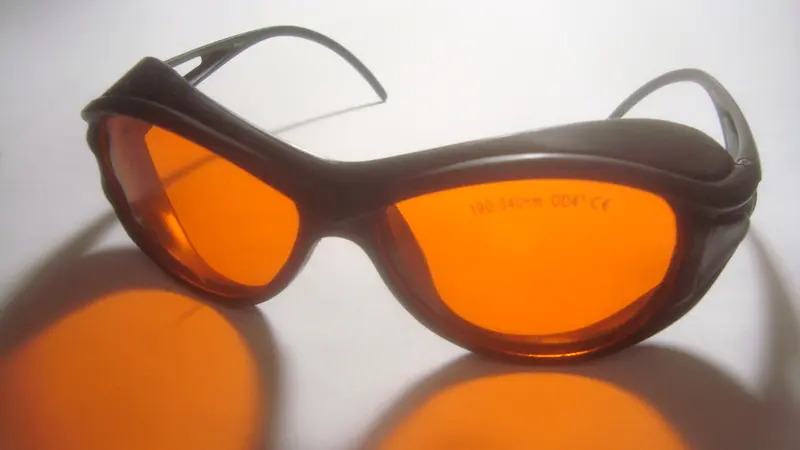
Laser safety goggles rated for 190–540nm at OD4+ (blue and green lasers) Photo: Карма2, CC BY-SA 4.0 Sources: PHE/UKHSA — Ubiquitous Lasers (introduction to lasers and laser safety, PDF) · xTool — Safety Goggles Selection · OPSS — Product Safety Report: Falcon2 Magical Colorful Engraving Machine (2310-0021)
Fume extraction & filters
-
Fume extractor and filter unit
For lasersLaser cutting and engraving produce smoke, gases and fine particles. Glowforge, for example, says its machines must only run when exhausted outdoors or through its filter. Where you can’t vent outside, a filter unit draws the exhaust through filters and returns cleaner air to the room.
What to look for
- Designed for laser fumes, with an inlet that matches your machine’s exhaust port.
- Several filter stages — typically a pre-filter for particles and activated carbon for gases and odours.
- Replacement filters that are easy to buy, and a way to tell when they’re full.
- Enough airflow for your machine; the maker’s own filter is the safest match.
Search Amazon.co.uk for “laser engraver fume extractor”
Sources: Glowforge — Safety: Glowforge Performance Series · HSE — INDG408 Clearing the air: a simple guide to buying and using LEV (PDF)
-
Exhaust ducting to a window
For lasersMost enclosed lasers come with an exhaust fan and hose designed to vent through a window. HSE describes extraction systems as a hood, ducting, an air cleaner, a fan and a discharge point — the same idea at home: keep the path short, sealed and pointed away from people.
What to look for
- Ducting of the same diameter as your machine’s exhaust, with secure clamps.
- A window insert or vent panel so the window can stay mostly closed.
- Keep the run short with few bends; check it isn’t blowing fumes towards a neighbour’s window or a door.
Search Amazon.co.uk for “window vent kit for 4 inch ducting”
Sources: HSE — INDG408 Clearing the air: a simple guide to buying and using LEV (PDF) · Glowforge — Safety: Glowforge Performance Series
Fire safety
-
Carbon monoxide alarm
For lasersGlowforge advises installing and testing carbon monoxide detectors, because lasering can produce carbon monoxide among its fumes. An alarm near the machine is a cheap extra safeguard.
What to look for
- Fit and test it following the alarm maker’s instructions.
- Replace it by the end-of-life date printed on the unit.
-
Fire extinguisher suited to electrical fires
Lasers & printersEvery laser maker we checked says never to leave a job unattended, and xTool recommends keeping CO2 extinguishers to hand. UK fire services list CO2 (black label) or dry powder extinguishers for fires involving electrical equipment — with CO2 used only in well-ventilated spaces and dry powder not in enclosed spaces. Water extinguishers are for solids only, not electrics.
What to look for
- A CO2 extinguisher sized for a small room, mounted near the exit rather than behind the machine.
- Conforms to BS EN 3.
- Learn how to use it before you need it, and call 999 if a fire spreads.
Search Amazon.co.uk for “co2 fire extinguisher 2kg”
Sources: xTool — xTool F1 Ultra Safety First · Hampshire & Isle of Wight Fire and Rescue Service — Fire safety equipment · Avon Fire and Rescue Service — Fire extinguishers · London Fire Brigade — Fire Safety Guidance Note GN08: Hand Held Portable Firefighting Equipment (PDF)
Air assist
-
Air assist pump and nozzle
For lasersAir assist blows a jet of air at the cutting point to clear smoke and debris. It helps reduce flare-ups and scorching, and usually gives cleaner cuts. Many enclosed machines have it built in; open-frame diode lasers often take an add-on kit.
What to look for
- Made for (or listed as compatible with) your laser head.
- Adjustable airflow — full flow for cutting, lower for engraving.
- Check the noise level if the machine is in a shared space.
Search Amazon.co.uk for “laser engraver air assist pump”
Sources: xTool — Safety Guide for xTool D1 Laser Cutting & Engraving
Enclosures
-
Enclosure for an open-frame laser
For lasersAn enclosure around an open-frame diode laser helps contain smoke so it can be extracted, and keeps hands and pets away from the moving head. It doesn’t make the laser eye-safe on its own: xTool’s guide for its open-frame D1 says that even with a hood you still need safety glasses.
What to look for
- Fire-resistant panels and an exhaust port you can connect to ducting or a filter.
- A viewing window with filtering matched to your laser’s wavelength.
- Enough room around the machine for its full travel and any rotary.
Search Amazon.co.uk for “laser engraver enclosure”
Sources: xTool — Safety Guide for xTool D1 Laser Cutting & Engraving · HSE — INDG408 Clearing the air: a simple guide to buying and using LEV (PDF)
-
Enclosure for a 3D printer
For 3D printersAn enclosure keeps a steady temperature for warp-prone filaments and helps control emissions. University safety guidance from Edinburgh, citing HSE laboratory research, reports that a filtered enclosing hood cut particle emissions into the room by 97–99%, and recommends leaving it closed for at least 20 minutes after printing.
What to look for
- Big enough for the printer’s full movement, with a door and cable access.
- A fan with HEPA (particles) and activated carbon (fumes) filtration for better air control.
- Fire-resistant materials; keep the printer’s own thermal protection working.
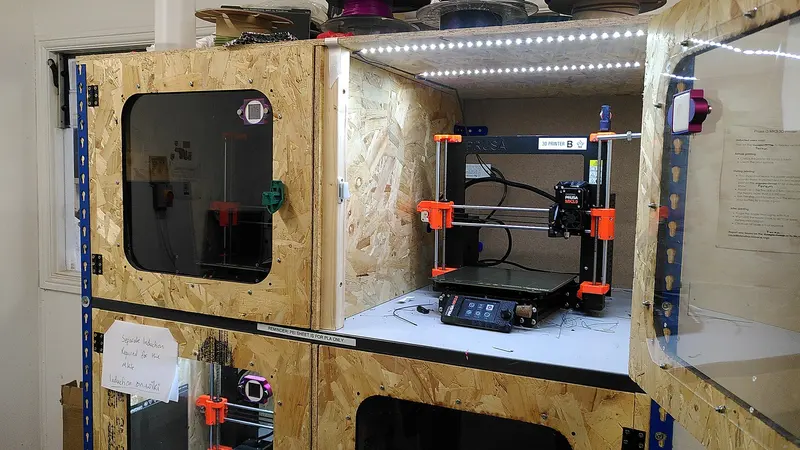
A 3D printer in a home-made enclosure at Bristol Hackspace Photo: penyuan, CC BY-SA 2.0 Search Amazon.co.uk for “3d printer enclosure”
Sources: University of Edinburgh Health and Safety — 3D Printers · University of Reading — Safety Note 74: Use of Polymer Filament Desktop 3D Printers (PDF)
Honeycomb beds & slats
-
Honeycomb bed
For lasersAn aluminium honeycomb grid that supports material on the bed. Smoke escapes underneath and there are fewer scorch marks on the back of cut parts than on a solid surface.
What to look for
- Sized for your machine’s working area.
- A frame and pins or clips to hold thin, curling material flat.
- Clean it regularly — Glowforge and xTool both warn that built-up debris is a fire risk.
Search Amazon.co.uk for “laser honeycomb bed”
Sources: Glowforge — Safety: Glowforge Performance Series · xTool — Safety Guide for xTool D1 Laser Cutting & Engraving
Rotary attachments
-
Rotary attachment
For lasersA rotary turns cylindrical items — tumblers, glasses, rolling pins — under the beam so you can engrave around them. Roller rotaries cradle the object; chuck rotaries grip it, which suits tapered or awkward shapes.
What to look for
- Listed by your laser’s maker as compatible, and supported in your software.
- Maximum and minimum object diameter that suits what you want to engrave.
- Enough height clearance — some enclosed machines need a riser base to fit a rotary.
Filament dryers & storage
-
Filament dryer
For 3D printersFilament absorbs moisture from the air, which turns to steam in the hot nozzle and causes stringing, holes, rough surfaces and weaker parts. Bambu Lab advises drying when in doubt, and drying engineering filaments before use; Prusa says nylon should be dried for at least four hours below 90 °C.
What to look for
- Temperature settings that cover the filaments you use — check each filament maker’s drying temperature.
- Room for your spool size, ideally with a feed hole so you can print straight from the dryer.
Search Amazon.co.uk for “filament dryer box”
Sources: Bambu Lab Wiki — Filament drying · Prusa Knowledge Base — Polyamide (Nylon)
-
Airtight filament storage with desiccant
For 3D printersOnce filament is dry, keep it that way. Prusa recommends storing nylon airtight with desiccant, and the same approach helps PETG and TPU.
What to look for
- Sealed boxes or bags big enough for a full spool.
- Silica gel desiccant you can dry and reuse, plus a humidity indicator.
Search Amazon.co.uk for “filament storage box desiccant”
Sources: Prusa Knowledge Base — Polyamide (Nylon) · Bambu Lab Wiki — Filament drying
Build plates
-
Spare build plates
For 3D printersRemovable spring-steel plates with a smooth or textured coating flex to release prints. A second plate lets you start the next print while the first cools — and different surfaces suit different filaments.
What to look for
- Exactly the right size and type for your printer’s magnetic bed.
- Smooth PEI for glossy bottoms; textured PEI for easy PETG release and a hidden-mark finish.
- Follow the plate maker’s cleaning advice.
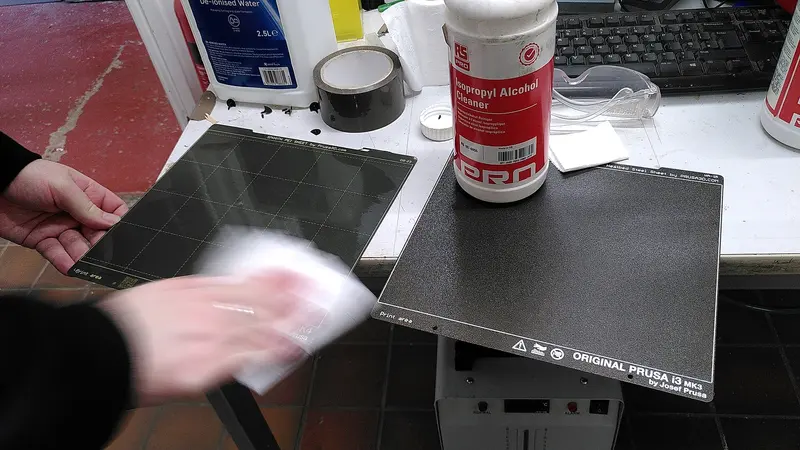
Cleaning a flexible build plate with isopropyl alcohol at Bristol Hackspace Photo: penyuan, CC BY-SA 2.0 Search Amazon.co.uk for “pei build plate”
Sources: Bambu Lab Wiki — Filament guide (printer, nozzle, AMS, build plate compatibility)
Resin washing & curing
-
Nitrile gloves and safety glasses for resin
For 3D printersLiquid resin can irritate skin and cause allergic reactions. Formlabs recommends nitrile or neoprene gloves and safety glasses when handling resin and wash solvents.
What to look for
- Nitrile (not latex) gloves in your size, changed when contaminated.
- Splash-resistant safety glasses.
Search Amazon.co.uk for “nitrile gloves”
Sources: Formlabs — Safety with Formlabs SLA products · Prusa Knowledge Base — Resins
-
Resin wash and cure station
For 3D printersResin prints are washed (usually in isopropyl alcohol, or water for water-washable resin) and then post-cured under UV light. A combined station does both. IPA vapour is flammable, so keep it closed and away from heat and sparks — and never pour used wash liquid down the drain.
What to look for
- Big enough for your printer’s build plate.
- A lid that seals the wash container when not in use.
Search Amazon.co.uk for “resin wash and cure station”
Sources: Formlabs — Safety with Formlabs SLA products · Formlabs — Disposing of resin · Prusa Knowledge Base — Using the CW1: Washing
Other
-
Hardened steel nozzle
For 3D printersCarbon- and glass-fibre filled filaments are abrasive. Bambu Lab and Prusa both say to print them with a hardened steel nozzle; brass and stainless steel nozzles wear quickly.
What to look for
- Made for your printer’s hotend — nozzles are not interchangeable between brands.
- The same diameter you normally slice for (commonly 0.4mm).
Search Amazon.co.uk for “hardened steel nozzle 0.4”
Sources: Bambu Lab Wiki — Filament guide (printer, nozzle, AMS, build plate compatibility) · Prusa Knowledge Base — Composite materials (filled with carbon, kevlar or glass)
Amazon links are affiliate links. As an Amazon Associate I earn from qualifying purchases. We never show Amazon prices or ratings — check them on Amazon.